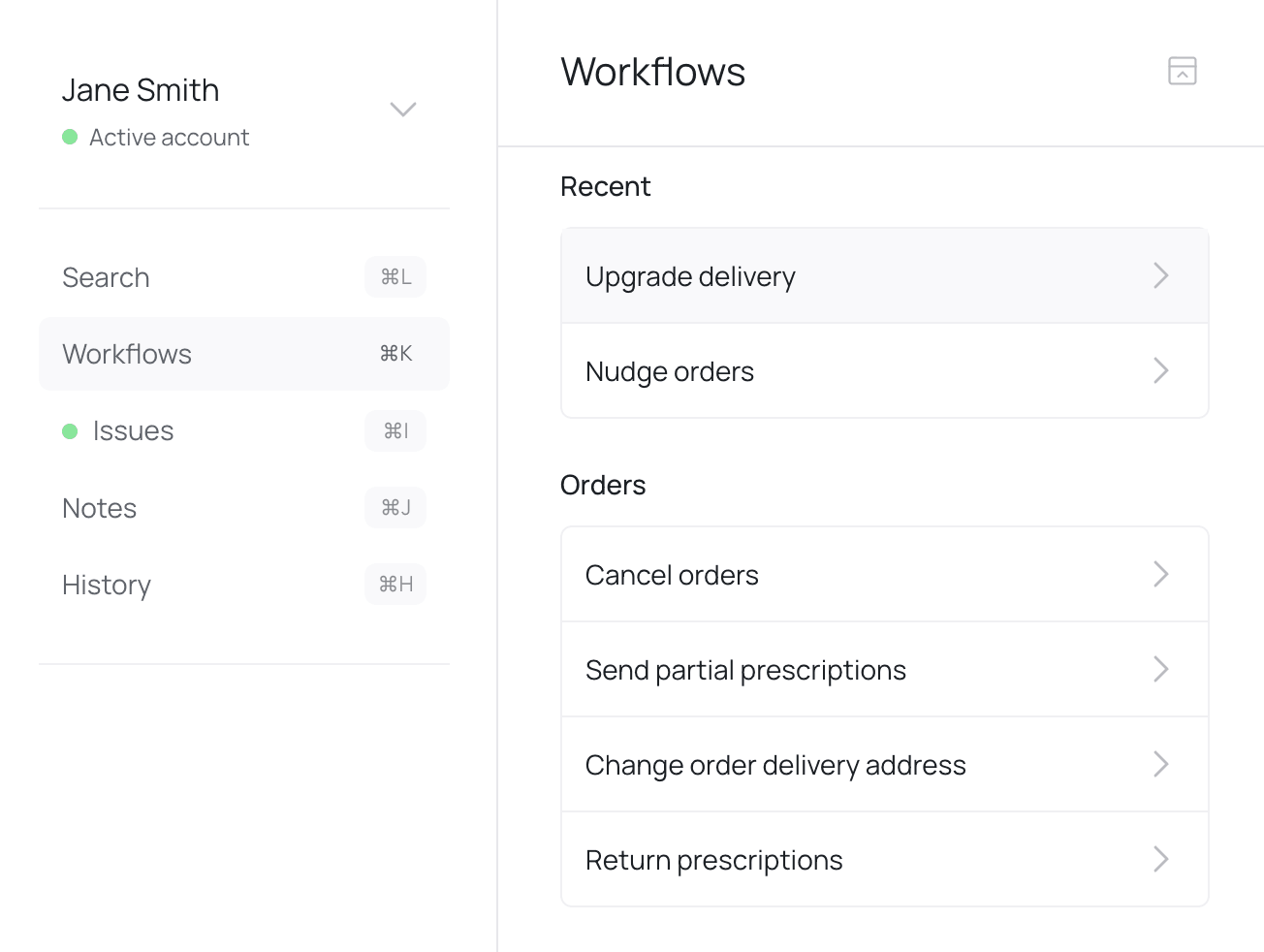
Rethinking how 200+ agents manage patient prescriptions and conversations
Leading research, design, and engineering alongside backend engineers, co-designing with support advisors and pharmacists who would use the tool daily, I set out to solve a problem that was making everyone's day harder: advisors were juggling multiple systems whilst actively talking to worried patients. Looking up orders in one tool, prescriptions in another, consultation history somewhere else. Context switching killed efficiency. Patients had to repeat themselves. The challenge was building a unified console that could keep pace with real conversations without getting in the way.
Too many systems, too many worried patients
Support advisors were looking up orders in one tool, prescriptions in another, consultation history somewhere else. All while keeping a worried patient on the line. Context switching killed efficiency. Patients had to repeat themselves when they spoke to different advisors. Resolution times dragged.
The solution
A unified console that brought everything together and integrated directly with Aircall and Intercom.
Built with Next.js and GraphQL, the app orchestrates communication with a complex web of microservices (orders, prescriptions, consultations, patient records) all through a single, fast interface.
Key features:
Unified patient view
showing orders, prescriptions, consultations, and issues at a glance, scannable in seconds
Keyboard-first workflows
so advisors could complete common tasks without leaving the call or reaching for a mouse
Full audit trails
tracking all activity, so the next advisor picks up exactly where the last one left off
Integrated communications
with Aircall and Intercom baked right in
Speed and micro-interactions
When you're performing the same tasks hundreds of times a day, every millisecond counts. The interface was designed around speed:
Instant search
with results appearing as you type, no loading states
Keyboard shortcuts
for every common action, advisors rarely needed to reach for a mouse
Optimistic updates
that respond immediately, syncing in the background
Micro-interactions
that provide instant feedback without slowing the flow
The goal was an interface that gets out of the way. Muscle memory develops fast when the system is consistent and predictable.
Built with, not for
I started with an early prototype and sat with advisors to watch them use it. Every pain point they hit became an immediate priority. The tool evolved through direct feedback, not assumptions.
What changed
Faster resolutions. Fewer repeat contacts. Patients stopped having to explain their situation three times. Advisors could actually focus on helping instead of hunting for information.