
A digital platform for the European Commission to support EU citizens in the UK during Brexit
Contracted by the European Commission, the EU Rights Platform was a digital service built to help millions of EU citizens navigate their rights during one of the most turbulent periods in recent European politics. Sole designer and developer across two contract phases, covering everything from user research and interface design through to deployment and handover.
3.6 million people, uncertain of their rights
The 2016 Brexit referendum left EU27 citizens in the UK facing deep uncertainty about their right to live, work, and access services. The European Commission, EU27 embassies, and a network of charitable organisations were running hundreds of information events and providing pro-bono legal support across the country, but there was no central platform to coordinate any of it. Citizens had no reliable way to find events or services near them, and the organisations running these services had no shared tools to manage or monitor what was happening on the ground.
Public information platform
Location-based search connecting EU citizens with free legal events, pro-bono services, and rights information across the UK
Multi-org administration
Event and service management used by all 27 EU embassies, the Law Centres Network, and dozens of NGOs
EUSS monitoring tool
Anonymous case recording and analysis platform for tracking systemic issues with the EU Settlement Scheme
Connecting citizens with support across the UK
The first contract (2018) delivered eurights.uk, a public-facing platform connecting EU citizens with the support available to them.
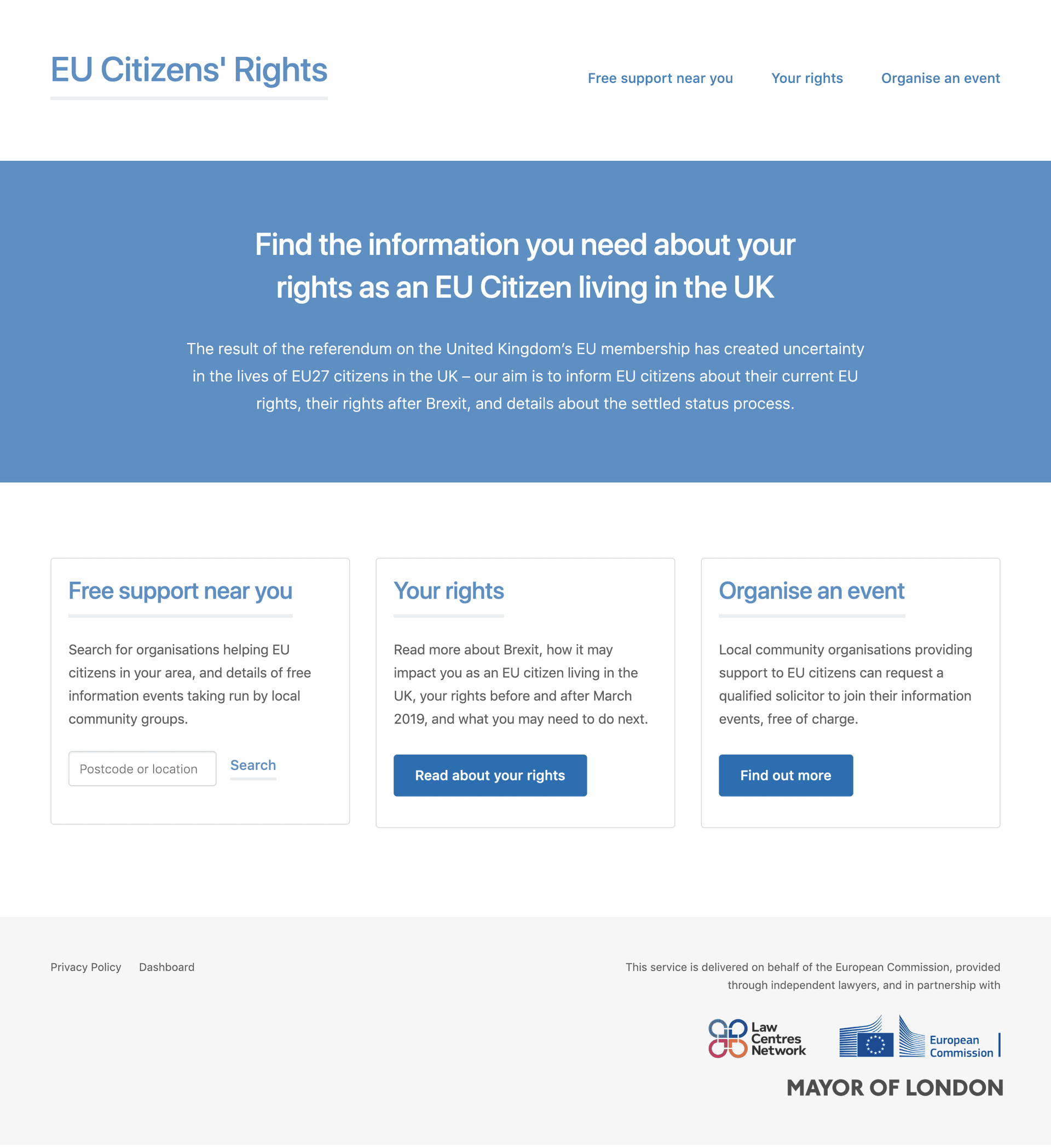
The homepage gave citizens three clear routes in: find free support nearby, understand your rights, or organise a community event. The platform needed to serve people in genuinely stressful situations, so clarity and simplicity were non-negotiable.
Events, services, and solicitors on a map
Citizens could search by postcode or town to find both upcoming information events and pro-bono service providers within their area. Results were plotted on an interactive map alongside a list view, showing everything from immigration advisers and legal aid to mental health services and translators.
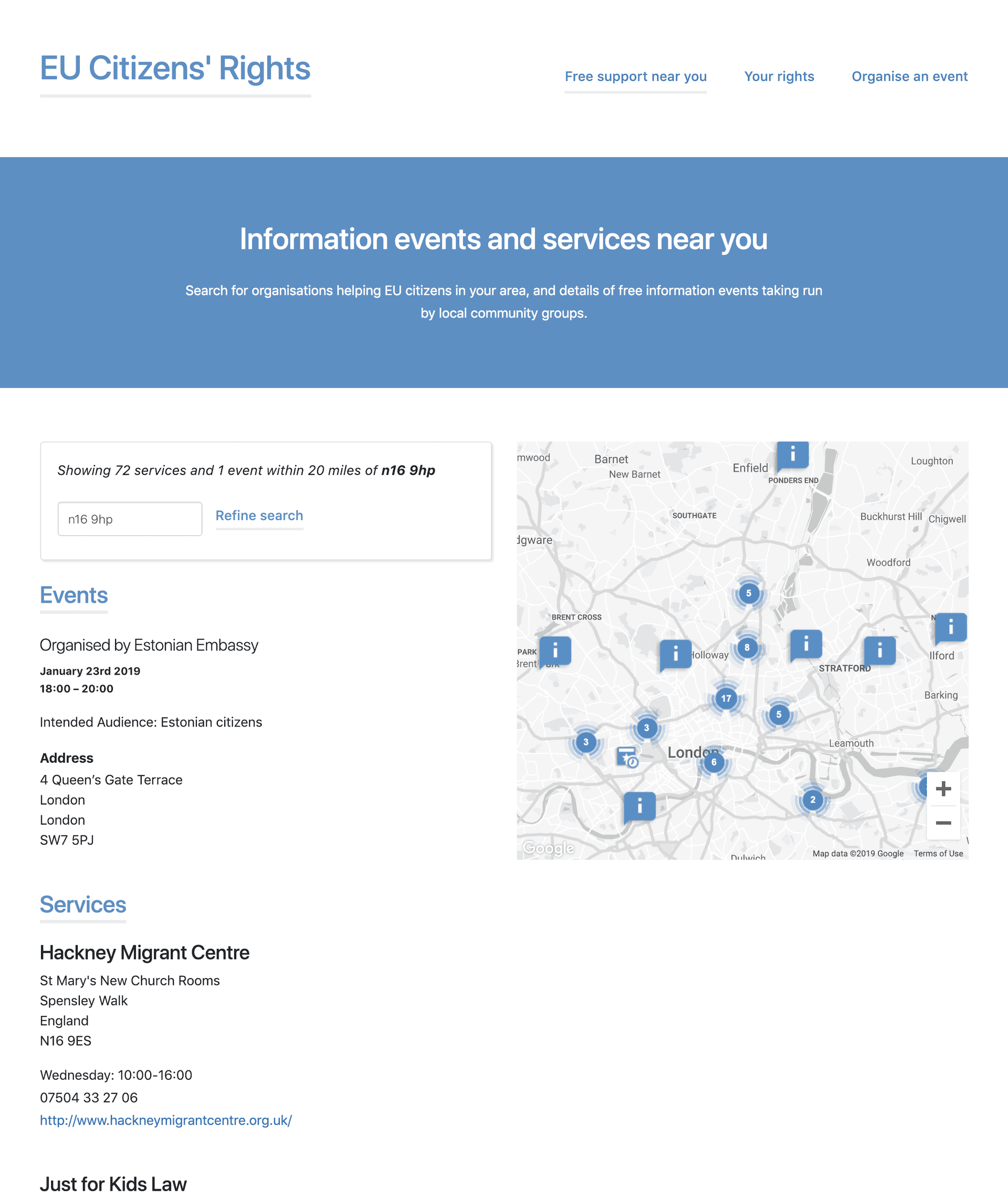
The services database covered a complex taxonomy of provider types and beneficiary demographics, from immigration advisers and vulnerable persons charities through to specific European communities, housing support, and disability access services. Categories were colour-coded on the map so citizens could quickly distinguish between service types at a glance.
Making the Withdrawal Agreement accessible
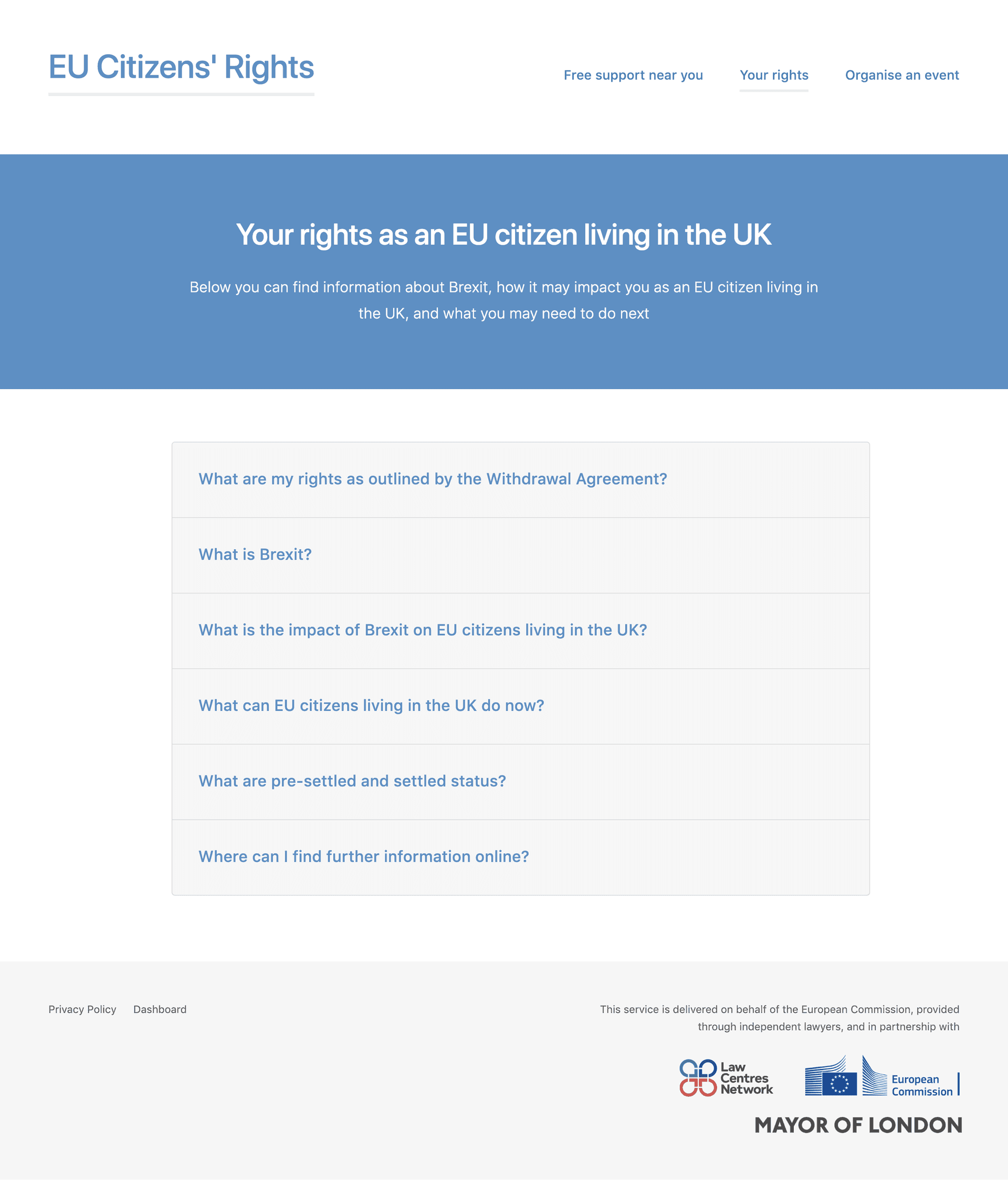
A dedicated section provided accessible information about the Withdrawal Agreement, what Brexit meant in practice for EU citizens, and the steps people needed to take to secure their status. Content was managed by the European Commission and kept current as the political situation evolved.
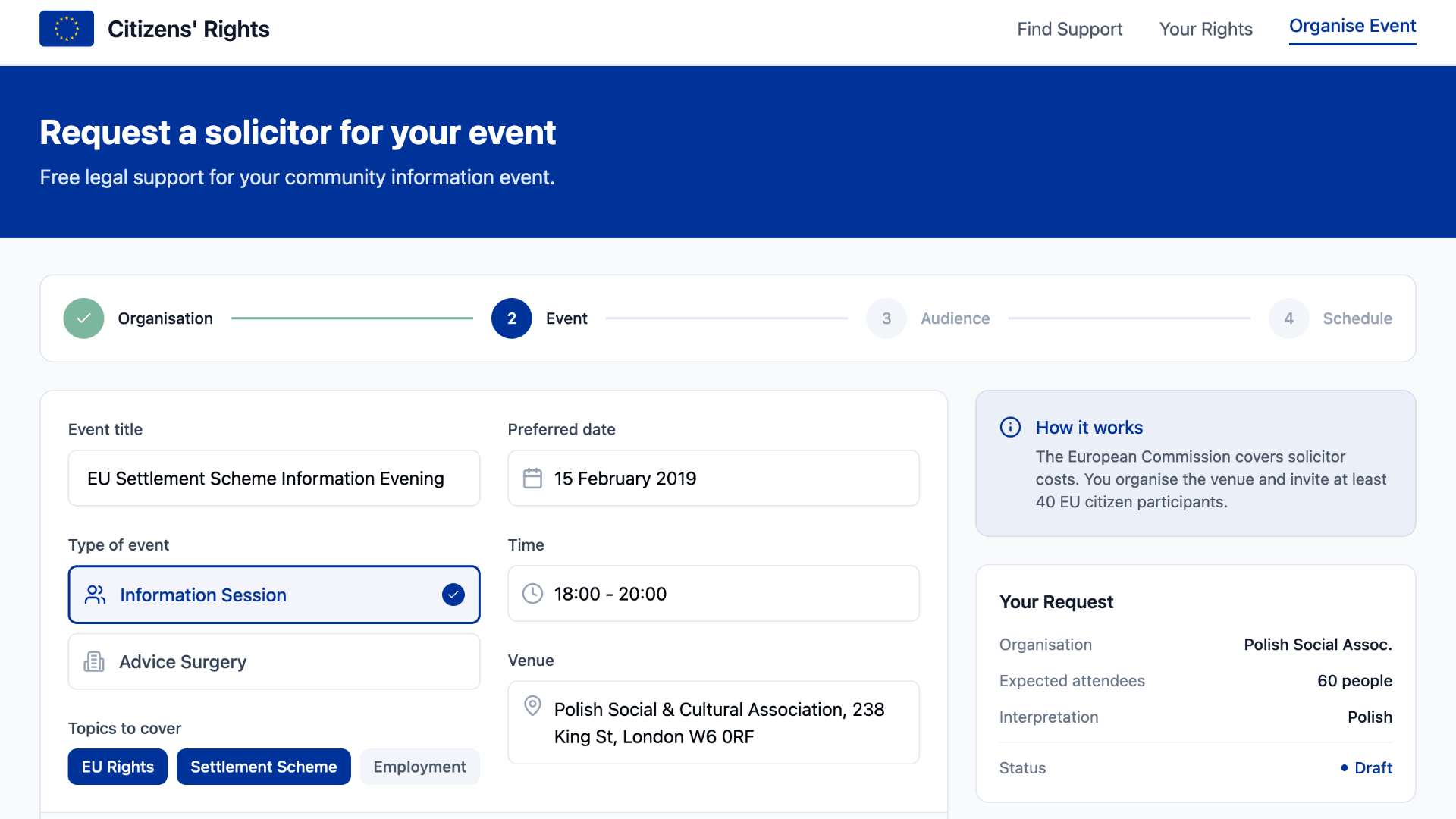
Free solicitors for community events
Community organisations anywhere in the UK could request a qualified solicitor to attend their information event, completely free of charge. The platform handled the full request workflow: the organisation would specify their audience, preferred dates, venue details, and any particular needs, and the request was routed through to the Law Centres Network for fulfilment. This turned the platform from a passive directory into an active coordination tool, making it far easier for grassroots groups to get professional legal support to their communities.
27 embassies, one shared dashboard
Behind the scenes, the platform supported a multi-tenanted administration system. EU27 embassies, Europe Direct centres, the Law Centres Network, and other approved organisations could each register and log in to manage their own events and services. Events moved through a structured approval workflow before appearing on the public site, with the European Commission retaining final sign-off. The dashboard gave each organisation a view of their own activity alongside platform-wide statistics, with filtering, search, and CSV export across the board.
Tracking systemic issues with the Settlement Scheme
The second contract (2019) added a substantially more complex piece of work. By this point, the UK had launched the EU Settlement Scheme (EUSS), and a monitoring network of embassies, the Commission, and NGOs had formed to track systemic issues with the application process and the functioning of the new immigration status.
The network needed a way to share anonymised casework. The project began with workshops involving network members to assess feasibility, followed by the design and build of a case monitoring tool that sat alongside the existing platform.
Anonymous case recording at scale
Organisations could submit detailed case records about issues their clients had encountered, capturing everything from the nature of the problem through to demographic information about affected citizens. Forms supported conditional logic, where selecting certain answers revealed further sub-questions, along with file uploads for supporting documentation. All case data was anonymised by design, with no names, email addresses, or identifying information stored. Records were scoped to each organisation, so members could only manage their own casework while administrators retained a view across the entire network.
A form that evolves with the crisis
The Commission needed to be able to evolve the case record form over time as new issues emerged. Rather than hardcoding a fixed questionnaire, the solution was a dynamic form system where administrators could manage sections, fields, and data types themselves, adding new questions or modifying existing ones without any code changes.
From raw casework to evidence
Submitted cases could be segmented and analysed through visual reports built into the platform. Administrators could create custom data segments, view charts and breakdowns, and export everything to CSV for further analysis. The tool also imported and displayed monthly and quarterly EUSS statistics published by the UK government, providing additional context alongside the qualitative casework.
Content management across the platform
The second phase also delivered CMS tools that allowed the Commission to edit content on key pages, manage text blocks on functional pages like the map and event forms, and create entirely new pages across the site without developer involvement.
Built for sensitive data and complex permissions
The platform was built with Ruby on Rails, backed by PostgreSQL with EU-hosted data storage. Authentication and role-based access control supported the complex multi-organisation permission model, and a geocoding service with Redis caching handled the location-based search. The dynamic form builder allowed administrators to modify the case record structure without developer involvement. Hosted on Heroku with SendGrid for transactional emails and AWS for file storage.
All code and intellectual property produced during the project remains the property of the European Commission.
220+ events coordinated, every EU embassy on board
The platform served as the central coordination point for EU citizens' rights information across the entire United Kingdom, used by all 27 EU member state embassies, the Law Centres Network, the Mayor of London's office, and dozens of charitable organisations. Over 220 events were managed through the platform, connecting citizens in communities across the country with free legal information and support services at a time when they needed it most.